A brilliant stranger just joined your team

Did you onboard your AI agents, or just hire them?

Vivari onboards them: they arrive knowing your world, work as a team, and earn trust one reviewed change at a time.

Runs the agents you already use, with cloud models or your own.

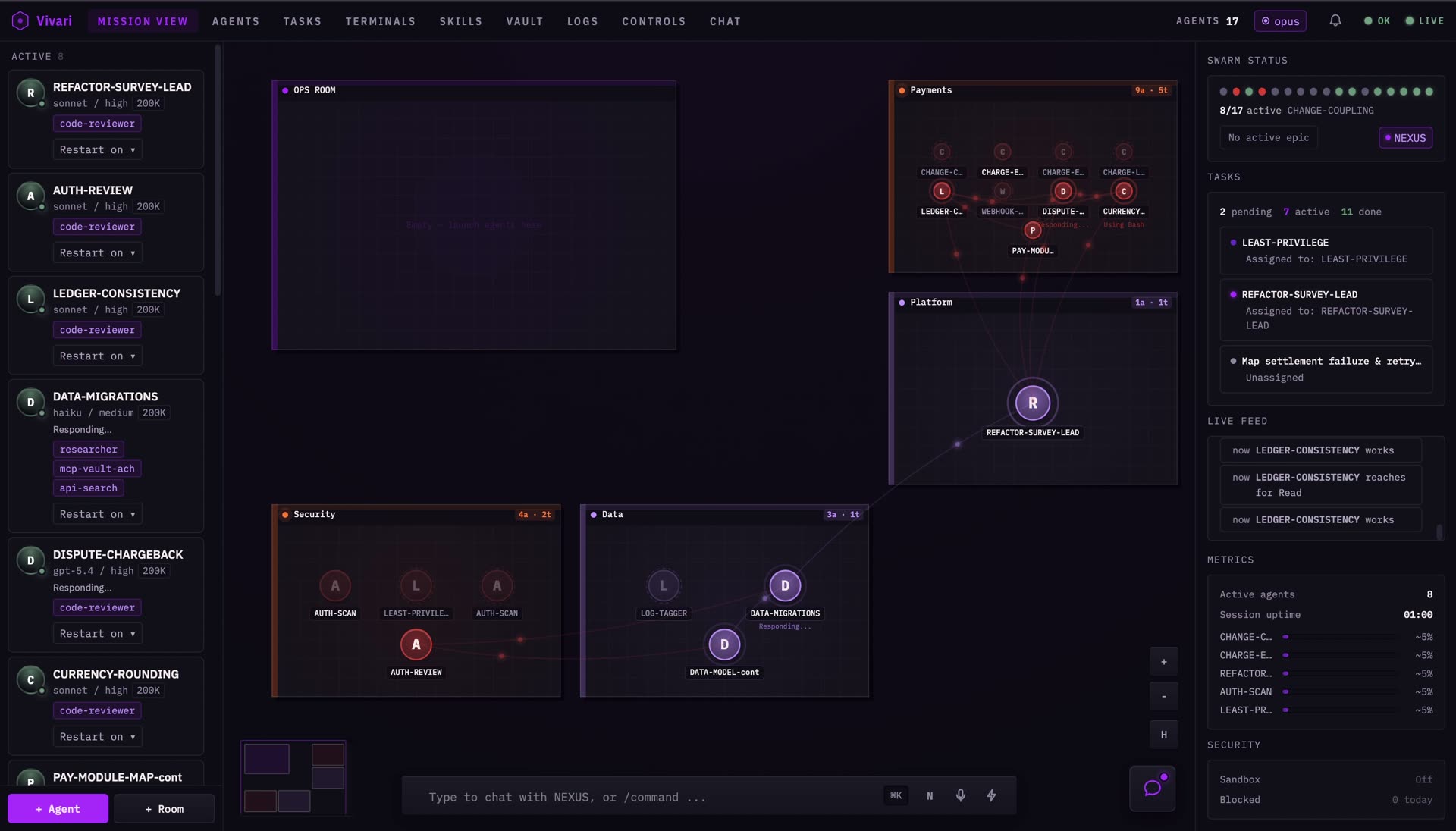
Vivari Mission View: rooms of AI agents (payments, security, data) working in parallel with live tasks and metrics

contextmemoryscoped accessreview · Guard

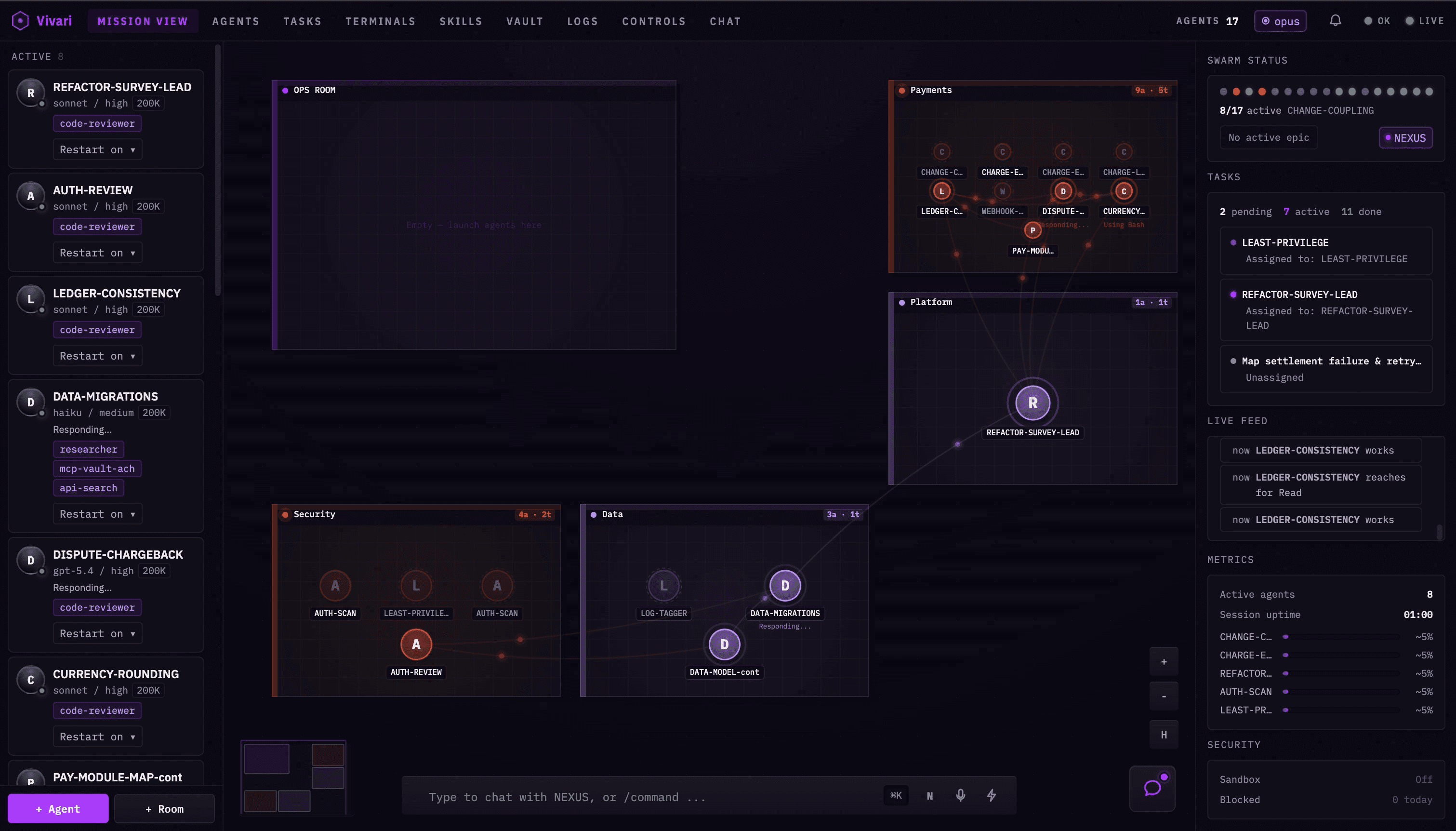
The Vivari fleet view - rooms of AI agents working in parallel, with live tasks, event feed, and burn metrics
Guard held a commitco-change evidence: 14/15

fleet

Run more agents, watch everything.

Rooms of agents working in parallel: what each one is doing, what it is costing, and a record of everything that has happened. The teal flag is Vivari Guard, the deterministic review engine, holding a risky change until a human clears it.

rooms · live tasks · eventsrooms · tasks · events

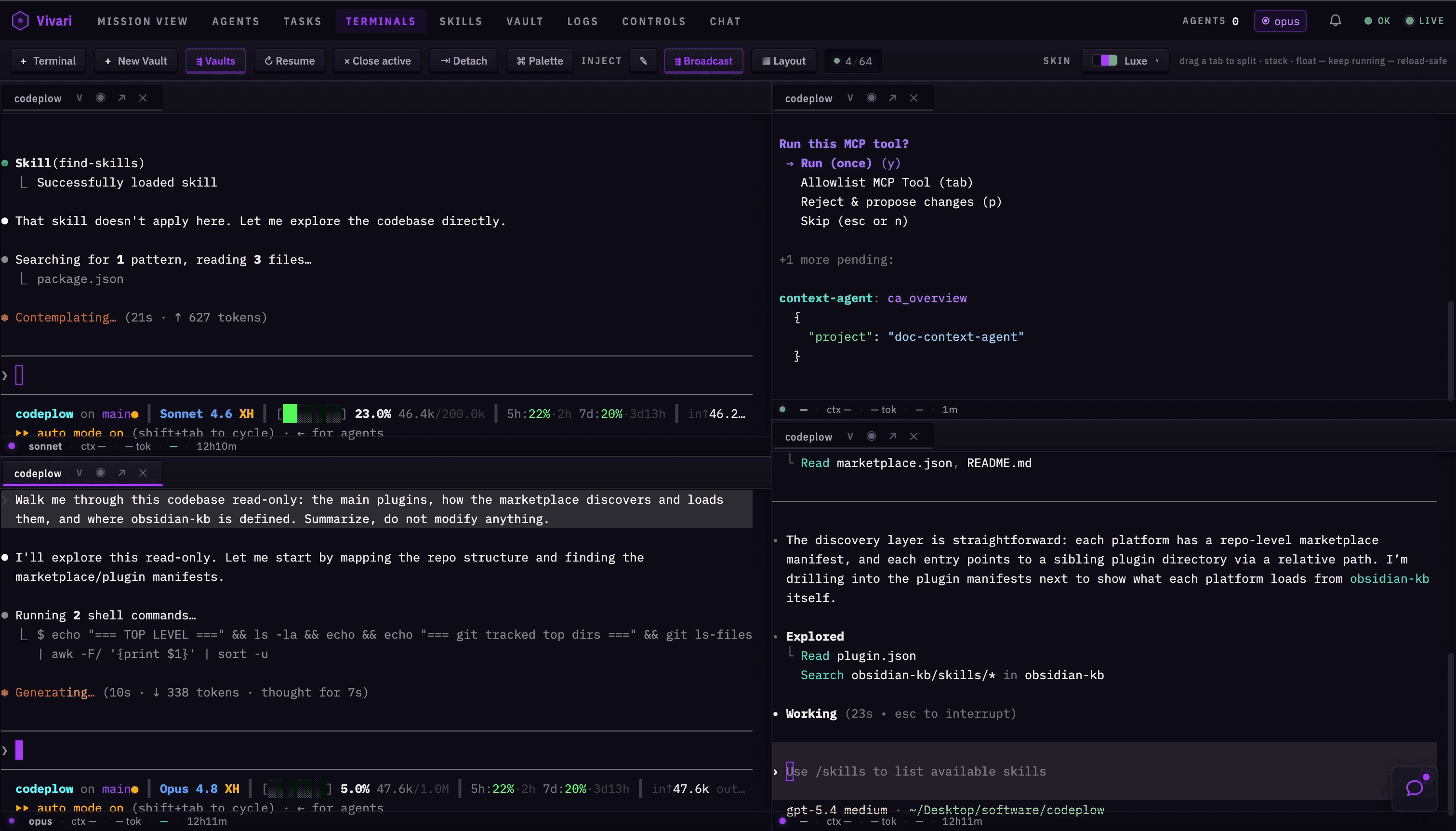
Vivari terminals side by side - streaming Claude Code sessions with context meters and queued approvals

fleet › room

Hands on the keys.

The same Claude Code, Codex, and Cursor sessions you already run, and your own models beside them, remote or fully local, opened inside a room that carries its context, its roles, and its review. Step into any session and take the wheel.

Claude Code · Codex · Cursor · todayyour sessions · today

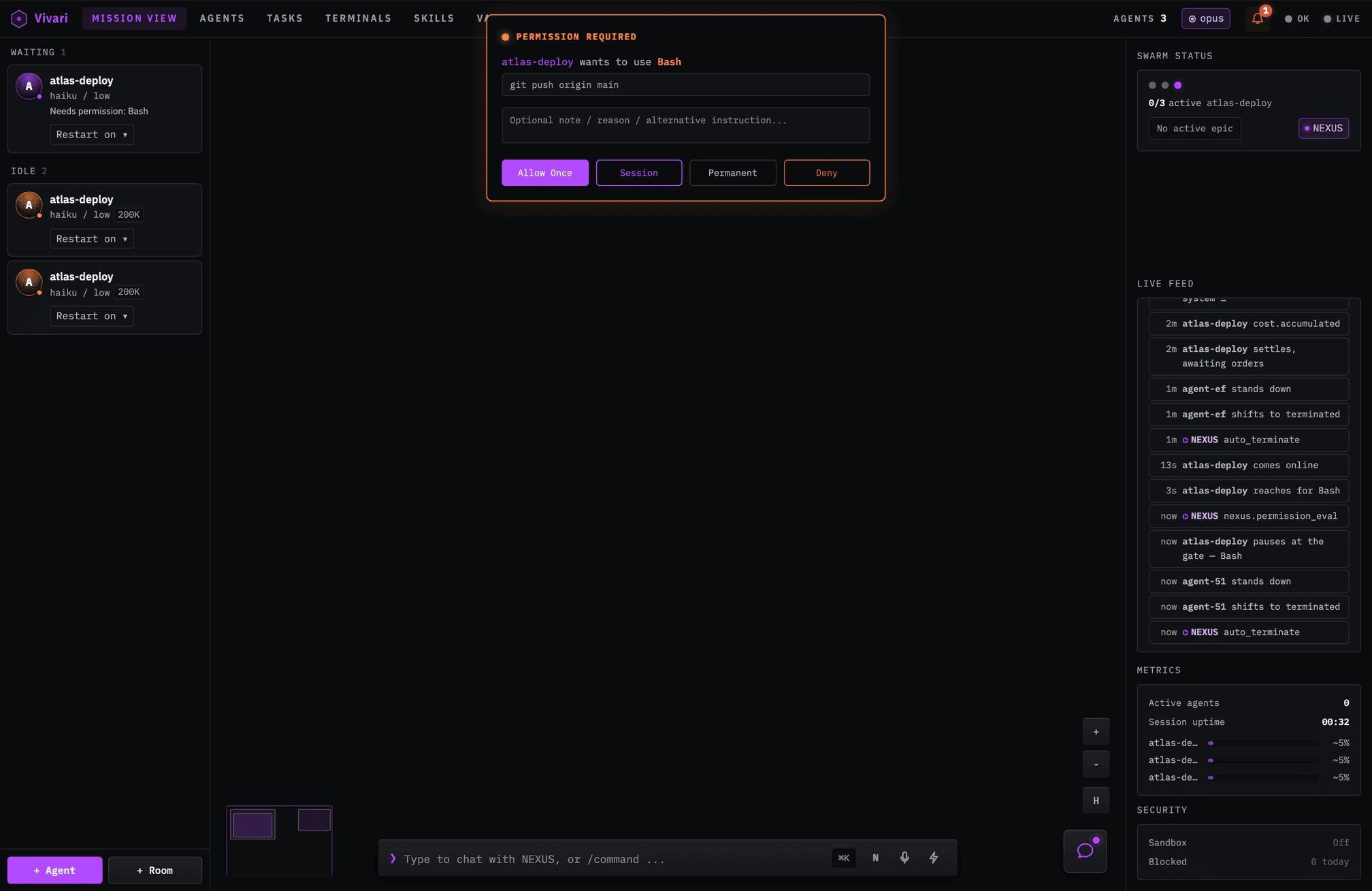
Vivari's permission gate holding an agent's git push - PERMISSION REQUIRED popup with Allow Once, Session, Permanent, and Deny options, filed in the audit trail

fleet › room › agent

No model clears its own risky actions.

Risky actions stop here: a shell command, a deploy, a database write, this push to main. The gate freezes it mid-flight for a human: allow once, this session, permanently, or deny. Until someone answers, nothing ships. The decision is filed in the audit trail.

asked · held · decided · filedasked · held · filed

Day one

Your first Monday.

9:04. You open Vivari to the agent you left mid-task on Friday: still in its room, still on budget, every step on the record. You are caught up in ten seconds. Then you widen the view, and the whole room comes into frame. No standup required.

The Conductor has been working between your prompts. It brings finished work for your eyes, and one thing it would not decide alone: a risky change, flagged teal, held until a human clears it. That human is you. You read the diff.

You clear it, or you take the wheel and finish it your way. Either way the decision is filed with the reason. By 9:30 the fleet is moving again, and the whole morning is one search away for as long as you need it.

What changes

What changes by Friday.

Receipts

Vivari's live fleet view: rooms of AI agents working in parallel, a swarm status rail, live task and event feeds
Vivari, today: a fleet at work. Mission View · Vaults · Terminals · Logs

The same review engine we sell gates every change to this website. Below is its live log from our own repository: each entry is a verdict on one commit, with the evidence that decided it one click away.

Vivari Guard, gating this website's own commits

PASSguard.premerge ae5d4870-030 · files 1 · coverage 100% · score 0.00 · 343ms · 2026-07-03receipt →

What is Vivari?

Vivari is the AI agent workspace: a living, observed environment where fleets of AI agents are put to work and kept accountable at the magnification you choose. Engineering agents ship code, research agents map a market, ops agents run the pipeline. It is the management layer for AI agents: context, shared memory, scoped permissions, deterministic safety review, full audit trails, and a human who can always take the wheel.

The idea is old. We just never applied it to agents. Organizations already know how to absorb a brilliant stranger: onboard them, scope their access to their role, review their early work closely, keep records, and keep a senior nearby. Vivari gives your agents exactly that, in one workspace. It runs the agents you already use (Claude Code, Codex, Cursor today, plus local and custom OpenAI-compatible models through the same harnesses), and shipping code is only the first job you'll hire them for:

You move between them the way deep strategy games move you: full pages when you want them, one continuous camera when you don't, and a shortcut you can summon from anywhere to jump straight to any of them. Hold V right now and try it on this page.

“A prompt is a sticky note. Onboarding is a map.”Wael Masri, founder

Plenty of tools can run many agents at once. The product is keeping each one accountable. The parts demos skip (memory with judgment, deterministic review, metered attention and cost, an audit trail that answers to you) are the parts we built first. The method explains each.


The manifesto

“We manage every human hire with care. We give AI agents the opposite, and then act surprised. The models kept getting better. The management never arrived.

Read the manifesto: A Brilliant Stranger in Your House

Who builds this

Built by a paranoid engineer. The reflex is earned: years shipping a security platform built for telemetry from hundreds of millions of sources, then fraud detection and real-time payment decisions at a fintech, then a security lab whose tooling shipped to red teams worldwide. All worlds where a wrong change is an incident. Vivari is that instinct, turned into a workspace.

Why I built Vivari →

The Stranger Test

You just hired a brilliant stranger.

Survive their first week. Eight decisions, about ninety seconds, no email. You leave with your Management Style Card.

Play The First Week

Questions

Which AI agents does Vivari work with?
The harnesses you already use: Claude Code, Codex CLI, and Cursor CLI today. Through those same harnesses, Vivari also runs local models and custom OpenAI-compatible endpoints, so your fleet is never locked to one vendor. More runtimes are planned, including Hermes by Nous Research. The workspace is engineering-first, but it manages any work you hire agents for: code, research, operations, content.
Is Vivari only for coding agents?
No. Shipping code is the first job most teams hire agents for, and Vivari Guard is purpose-built for change safety in code. The workspace itself manages fleets doing any knowledge work.
Is Vivari overkill if I only run one or two agents?
You do not need a hundred agents to have a management problem; you have one the moment a single agent gets meaningful access to your systems. One agent with write access already needs context on arrival, scoped access, review on risky changes, and a record of what it did. That is what the Solo tier is for, and the fleet features will be waiting when you grow.
Does my code leave my machines?
Vivari never uploads or mirrors your repositories to us, and we never train on your code. Vivari Guard's review runs entirely on your own machine, with no network call for the analysis. The security page maps the full picture, including what your chosen model provider sees.
Is Vivari reactive or autonomous?
Autonomous, accountably. Most tools wait for a prompt. The Conductor runs on a heartbeat: it watches the fleet, drafts and curates between your prompts (one model family proposes, a different one reviews), and brings you finished work. All under the same permissions, review, and audit trail as everything else. In auto mode a deterministic rule engine and risk evaluator decide what runs and what escalates to you: no model clears its own risky actions.
Won't better models make all this unnecessary?
The assumption is that a smarter model shrinks the management problem, and in practice it grows it. A weak model writes clumsy work you catch on sight; a powerful one writes convincing work, risky in ways you miss on first read, and faster than anyone can check. Checking is the half that does not speed up with the model. So every model upgrade raises the value of the layer around it, and Vivari is built so you can swap the model in the day a better one ships.
Couldn't we just build this ourselves?
Yes, and the parts are good: memory stores, sandboxes, observability, policy engines. A stack of parts still cannot answer the questions that matter, because each tool holds its own fragment of the story. The management model only exists when identity, context, permissions, evidence, and history are one system; start with the questions your stack cannot answer today.
When does Vivari launch?
Curated early-access cohorts open fall 2026. Cohorts stay small because every workspace gets guided setup and calibration against your own repositories.
Why should I believe any of this?
You don't have to take our word: the pre-merge log above is pulled live from this site's own repository, and every entry carries the commit and evidence behind its verdict. At launch, the receipts page goes live: the Vivari fleet sessions behind this site's build, and every deploy risk-scored by Vivari Guard. The manifesto explains the thesis. Then flip the question around: play The First Week: eight decisions, ninety seconds, a grade for how you treat your own agents.

Request early access

Vivari opens in curated cohorts starting fall 2026. Each cohort stays small because every workspace gets guided setup and calibration against your own repositories. Invitations go out in order of fit.

One email when your cohort opens. Nothing else. Pricing is announced at launch.